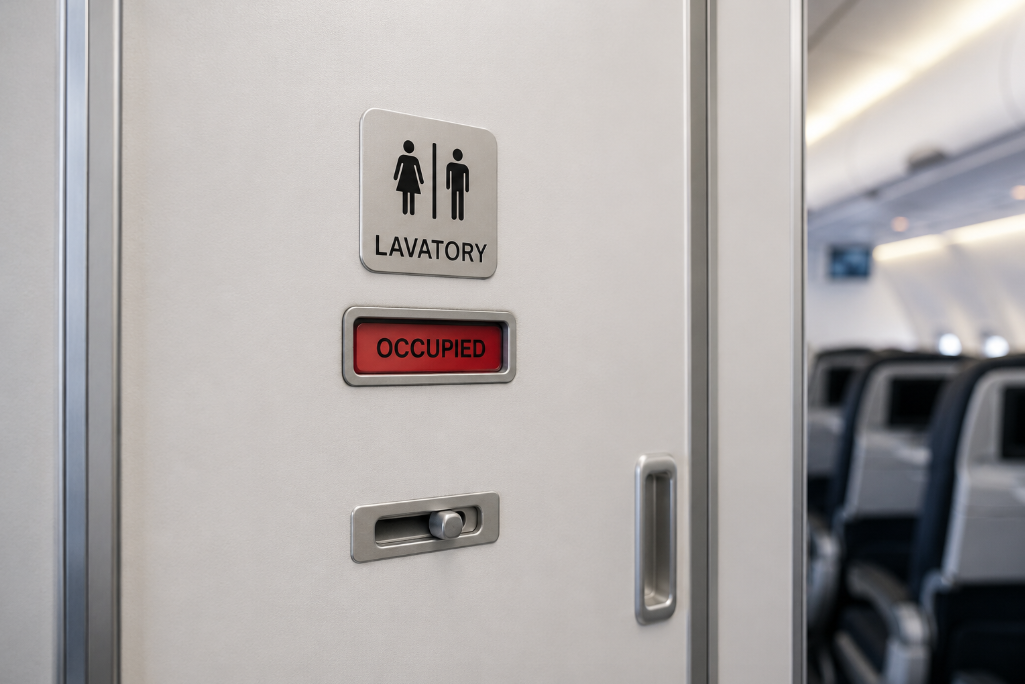
Ask travelers what matters on a longer flight and you'll hear familiar answers: a comfortable seat, good food, Wi-Fi, convenient connections. Rarely does anyone mention lavatories.
Yet, in an era when most airlines are investing heavily in differentiating their products, what increasingly shapes perceptions of quality are the invisible attributes: seats per lavatory, seats per flight attendant, crew work patterns, and how those variables interact with route length and cabin density.
Narrowbody aircraft now routinely operate transatlantic and other long-haul routes. Airlines are installing fully flat beds and private suites on single-aisle aircraft. Business class itself is fragmenting into basic, light, and fully bundled variants. As products become more sophisticated, labels become less informative, and these travel attributes that no one searches for become even more meaningful to the overall travel experience.
Why Lavatory Ratio Matters
Seats per lavatory sounds niche until you are five hours into a flight, the aisle is blocked, meal carts are out, and one lavatory is temporarily unusable. A higher passenger-to-lavatory ratio does not just mean longer waits; it also means more aisle congestion, more interrupted service, and heavier lavatory usage, which directly affects cleanliness and the perceived quality of the entire flight.
Surveys show that about three-quarters of passengers avoid using the lavatory whenever possible. That may be manageable on a 90-minute flight, but if you spend four or more hours in the air, statistically you will need to use it at least once.
The Numbers Behind the Experience
A rule of thumb in North American domestic operations is about one lavatory per 50 passengers, and approximately one per 35–40 passengers on long-haul flights. But these are average numbers that do not account for cabin-class differentiation and tend to smooth over some striking differences in aircraft configurations.
Recent outliers show how extreme the gap can become.
Delta's temporary high-density Airbus A321neo configuration places 44 first-class seats in the forward cabin with a single lavatory serving that cabin. The average ratio for business-class cabins on this aircraft type is closer to 20:1. Delta is mitigating the service impact with three flight attendants assigned to first class, but the lavatory constraint remains a striking example of how a premium cabin can look impressive on paper yet still create friction in practice.
Qantas' initial configuration for its new Airbus A321XLR, marketed as a long-range, comfort-focused narrowbody, places 200 seats on board: 20 in business class and 180 in economy. Yet the aircraft has only three lavatories in total. One is located at the front of the aircraft, effectively leaving two lavatories for 180 economy passengers—a ratio of 90:1. The average economy-class ratio for this aircraft type is closer to 60:1. Unsurprisingly, this quickly became a talking point on longer domestic sectors such as Sydney–Perth.
Long-haul widebodies often remain structurally better balanced, but even there, seat-to-lavatory ratios can vary by more than 50% between aircraft models and configurations.
And while most airlines officially state that passengers may use any onboard lavatory, cabin layouts often discourage or effectively prevent economy passengers from accessing lavatories in premium cabins, whether through physical separation or operational practice.
The Discovery Gap
But why do these invisible attributes create such visible pain? None of this information is truly hidden. Seat maps, fleet pages, airline amenity pages, and enthusiast websites all exist.
The challenge is not that the information is unavailable. The challenge is that it is disconnected from how people search.
Nobody opens a travel app and says, "Show me flights with fewer than 50 passengers per lavatory."
People say:
"I want a comfortable flight."
"I'm traveling with little children."
Those are expressions of intent, and the job of modern travel discovery is to translate them into the operational attributes that actually shape the journey.
This is the gap we focus on at Rocket Equation: turning those invisible product attributes into structured, actionable signals. Because no one should be expected to study cabin diagrams, but everyone deserves the best possible experience when flying.